
Did NASA Take Inspiration from a Turkish Scholar? A Century-Old Religious Text and the Moon Landing Debate
Did NASA draw inspiration from Turkish Islamic scholar Said Nursi’s 1930s writings about the Moon? As conspiracy theories resurface, the parallels spark curiosity.
 Editor2
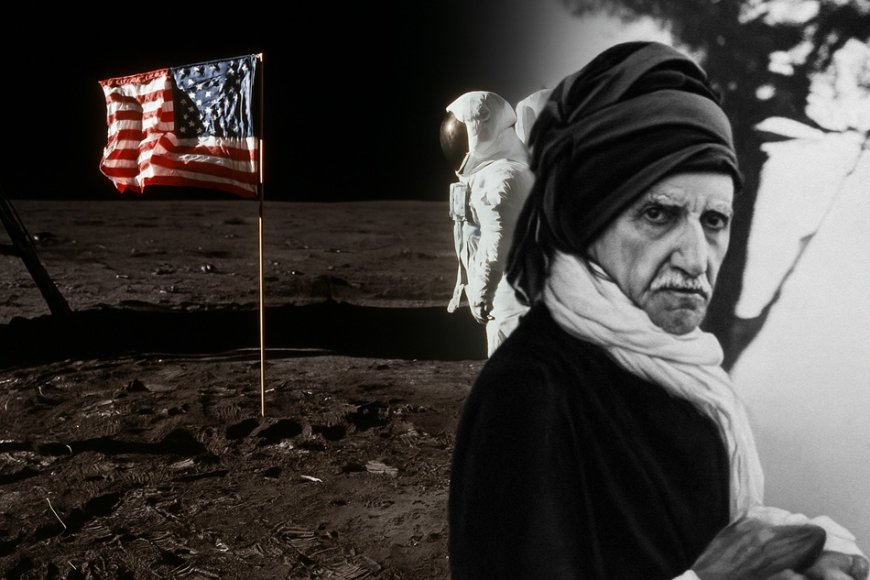


Did NASA Take Inspiration from a Turkish Scholar? A Century-Old Religious Text and the Moon Landing Debate
DREAMS WISDOM / ANKARA
As conspiracy theories about NASA’s historic Moon landing continue to captivate the public, a curious question emerges from Turkey: Could the U.S. space agency have drawn insight from an Islamic theological work written decades before Apollo 11’s liftoff?
A 20th-Century Muslim Scholar’s Remarkable Claim
Bediüzzaman Said Nursi, a revered Islamic thinker and author of the Risale-i Nur Collection, wrote between 1925 and 1931 about celestial phenomena in metaphorical and sometimes remarkably vivid detail. In his book The Words (Sözler), specifically the "Twenty-Fourth Word, Second Branch," Nursi refers to the Moon (kamer) as “dense and dark by its nature… without light or life.” The passage continues to emphasize that what appears to be light from the Moon is merely a reflection from another source—essentially, the Sun.
This theological reflection has recently been reinterpreted by some as a "spiritual prediction" of what modern science and NASA later confirmed: the Moon emits no light of its own and has no life-bearing atmosphere.
NASA’s Apollo Missions and Modern Findings
NASA's Apollo 11 mission, which launched on July 16, 1969, made history when Neil Armstrong stepped onto the Moon four days later. The mission, and five others that followed under the Apollo program until 1972, revealed key details: the Moon has no atmosphere, no life, and reflects sunlight. Astronauts also collected 382 kilograms of lunar soil, and even today, NASA’s Lunar Reconnaissance Orbiter (LRO) captures high-resolution images of the Moon’s surface and historic landing sites.


Despite this, conspiracy theories continue to fester. Fueled by early skeptics like Bill Kaysing and amplified by modern online platforms, claims about the Moon landings being staged persist. Questions about the flag's movement, the absence of stars in photographs, and the infamous "Kubrick hoax" are still cited in many circles.
Religion, Science, and Coincidence?
The parallels between Said Nursi’s religious descriptions and scientific findings have led some commentators in Turkey to suggest that NASA may have "secretly benefited" from these writings. Though no credible evidence supports this theory, the poetic similarity invites deeper discussions on the intersections of faith, science, and intuition.
For believers, Nursi’s writings reaffirm the spiritual depth and foresight of religious teachings. For skeptics and scholars, it’s more a case of metaphorical prose aligning—coincidentally—with empirical discoveries decades later.


Why Are We Still Debating the Moon Landing?
Despite overwhelming scientific evidence—including photos, video, telemetry data, and the testimony of over 400,000 engineers and workers involved in the Apollo missions—surveys show that belief in Moon landing hoaxes remains surprisingly high. Up to 20% of Americans, 25% of Britons, and 28% of Russians express doubts.
NASA, meanwhile, is preparing for a new era of lunar exploration through the Artemis program. Unlike Apollo, Artemis aims to establish long-term infrastructure on the Moon, enabling future missions to Mars and beyond.
A Mirror from the Past?
Whether or not NASA ever read The Words by Said Nursi, the discussion underscores how ancient wisdom and modern science can sometimes arrive at eerily similar truths. Coincidence or inspiration, this convergence continues to provoke reflection—not only about the Moon but also about the ways humanity seeks knowledge: through observation, faith, and imagination.
NASA, MoonLanding, Conspiracy, SaidNursi, RisaleiNur, Apollo11, Artemis, IslamicScience
Etiketler: #NASA #MoonLanding #SaidNursi #RisaleiNur #Apollo11 #Conspiracy #IslamicScholar #SpaceExploration