Earthquake in Ankara's Defense Sector: A Fidan-Bayraktar Rivalry or Putin's Strategic Move?
A deep dive into the alleged power struggle between Hakan Fidan and Selçuk Bayraktar. We analyze the connection between a defense firm takeover and Putin's timely strike on Baykar.
 Editor2


Earthquake in Ankara's Defense Sector: A Fidan-Bayraktar Rivalry or Putin's Strategic Move?
YUSUF İNAN / SPECIAL ANALYSIS / ANKARA
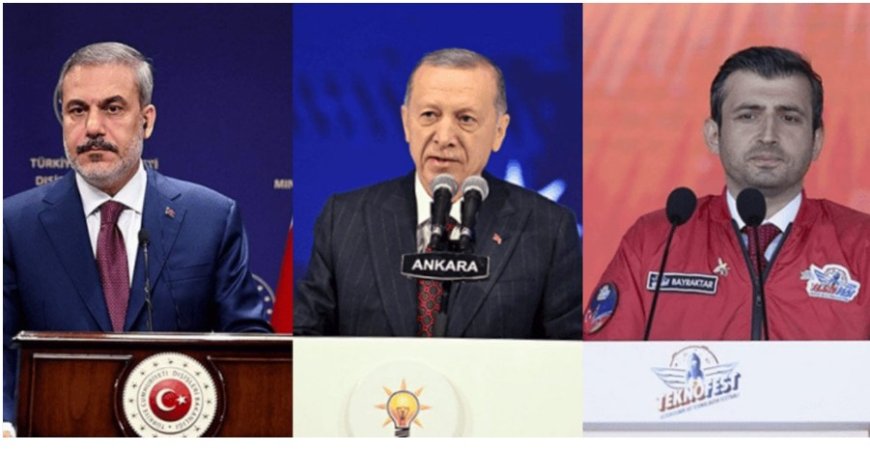
One of Turkey's most critical recent controversies began with the appointment of a government trustee to the defense industry giant, Assan International Defense Industry. While presented as a legal operation, allegations quickly spread through Ankara's political circles and media that the move was, in fact, an operation targeting a structure purportedly backed by Foreign Minister Hakan Fidan, and that the process was a reflection of a power struggle between Fidan and Baykar Chairman Selçuk Bayraktar. Just as this debate intensified, a subsequent event elevated the scenario to an international level: Russia struck and destroyed Selçuk Bayraktar's UAV production facility in Ukraine with a precision missile strike.
This meticulously timed attack raised questions beyond a simple military objective, chief among them: "Is Putin supporting Fidan by targeting Bayraktar?" Some commentators even interpreted the event as part of a broader plan by Putin to reshape the balance of power in Turkey. How should this complex chain of events be interpreted? Here is an examination of the analyses from U.S., European, Russian, and Ukrainian media, and the potential scenarios.


Perspective 1: The Internal Power Struggle Narrative & Turkish Media
The dominant debate within Turkish media centers on an internal power struggle. According to this narrative, a competition is unfolding between centers of power in Turkish politics and bureaucracy, particularly along the axis of the defense industry and foreign policy.
-
Two Centers of Power: On one side is Selçuk Bayraktar, representing an innovative-nationalist wing that is perceived as closer to the West through its technological achievements, popularity, and staunch support for Ukraine. On the other side is Hakan Fidan, seen as representing the state's traditional security bureaucracy, intelligence depth, and a more Eurasianist, pragmatic foreign policy approach. The operation against the Assan company is being interpreted as a power play between these two centers.

-
Media Reflections: While some pro-government outlets presented the operation as a legal necessity, opposition and some pro-Western commentators framed it as "a move by a faction within the state to limit the influence of the increasingly popular Bayraktar and the independent power he represents."


Perspective 2: The International Conspiracy & Putin's Strategic Signal
Russia's strike on the Baykar facility moved this domestic debate onto the global chessboard. The fact that the attack's timing was too precise to be a mere "coincidence" has led international analysts to various theories.
-
The Russian Media's Approach: Russian state channels RT and Sputnik defended the strike in purely military terms, stating that "a legitimate military target producing terror weapons used against Russia was destroyed." While avoiding direct commentary on Turkey's internal debates, they published indirect analyses suggesting that "pragmatic and sensible statesmen in Turkey should be more cautious about NATO's adventurist policies." This was widely seen as an implicit nod to the faction Fidan is thought to represent.
-
The Ukrainian Media's Assessment: For Ukraine, the situation was clear-cut. Publications like the Kyiv Independent and Ukrinform viewed the attack as "an enemy's move to destabilize and punish a strategic partner." Ukrainian analysts argued that Putin's aim was not only to damage Baykar's production capacity but also to create an environment of chaos and mistrust within Turkey, one of NATO's most critical members.
-
Analyses from U.S. and European Media: In the Western media, the issue was framed within the context of "Putin's hybrid warfare tactics."
-
An analysis in The Wall Street Journal stated, "Putin is skillfully exploiting potential power fault lines in Ankara. By targeting Bayraktar, he weakens a military adversary and simultaneously gives a strategic gift to a faction within Turkey he may consider more open to negotiation."
-
The French newspaper Le Monde highlighted the complex but functional dialogue channels Fidan had established with Russia since his tenure as head of intelligence, suggesting that Moscow might prefer a more balanced and transactional Turkey represented by Fidan over a technologically and militarily Western-integrated Turkey represented by Bayraktar.
-
The American journal Foreign Policy described the claim that "Putin is planning a change of power in Turkey" as "an exaggeration," but concluded that "Putin will not hesitate to use all tools at his disposal to influence Turkey's future leadership composition and foreign policy orientation."
-
Synthesis and Final Analysis: How Should This Process Be Interpreted?
-
Are the Events Connected? The timing between the Assan operation and the strike on the Baykar facility makes the coincidence hypothesis highly improbable. It is highly likely that Russia, closely monitoring Turkey's internal dynamics, seized upon this development as an opportunity for a military-political move.
-
What is Putin's Real Goal? The allegation that Putin is directly planning a "change of power" in Turkey is speculative and not supported by current evidence. A more realistic scenario is that Putin is conducting an "influence operation." His goal is likely not to install one leader over another, but rather:
-
To Punish an Adversary (Bayraktar): Baykar UAVs have inflicted heavy losses on the Russian military. This strike is both military and symbolic revenge.
-
To Deepen Existing Rifts: Whether the Fidan-Bayraktar rivalry is real or perceived, using it to create an atmosphere of mistrust and instability in Ankara serves Russian interests.
-
To Send a Signal for the Future: To message actors he considers more pragmatic that "we stand with you, and your adversaries are our adversaries."
-
Conclusion:
These events are a clear example of how even the slightest tension in Turkey's domestic politics can be transformed into a geopolitical opportunity by rival states. Whatever the legal justifications for the operation against Assan, the subsequent Russian attack demonstrated that the process is no longer just an internal affair.
Putin's move should be read less as a plan for a coup and more as a highly calculated strategic signal aimed at influencing the future direction of Turkey. This incident serves as a stark warning to all actors in Ankara that internal rivalries must not be allowed to become national security vulnerabilities.

YUSUF İNAN / PEACE AT HOME, PEACE IN THE WORLD (*)
Twitter : @Yusufinan2023
Instagram : yusufinan2023
Instagram : fondinan2016
Email : gundem@sehitlerolmez.com
Website : www.sehitlerolmez.com
(*) As Mustafa Kemal Atatürk, the founder of modern Turkey, once said, 'Peace at Home, Peace in the World.' This timeless principle serves as a guiding light for nations striving for harmony, coexistence, and global stability.