EU leaders fiercely condemn Orban's veto on Ukraine loan package
European Union leaders strongly condemned Hungarian Prime Minister Viktor Orban's veto of a €90 billion loan for Ukraine, stating the bloc will not yield to blackmail.
 Editor2


By Ahmet Taş | Wise News Press
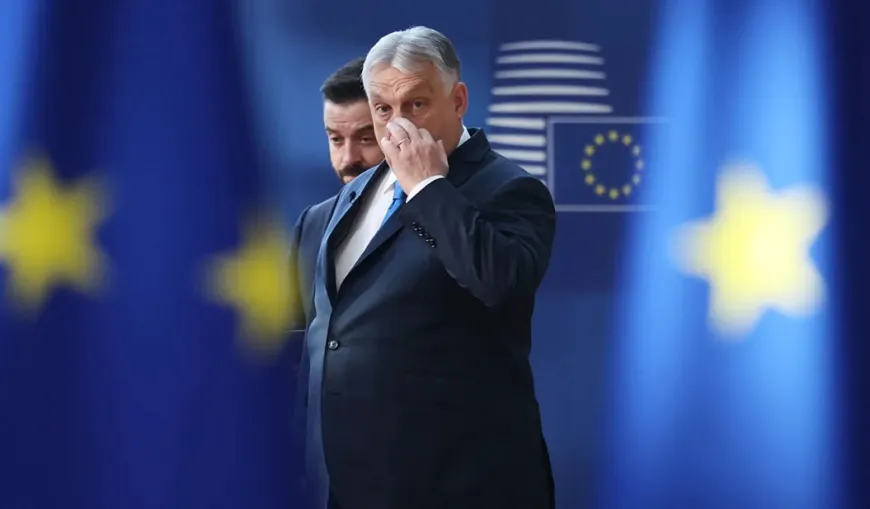
BRUSSELS, BELGIUM — European Union leaders have strongly condemned Hungarian Prime Minister Viktor Orban’s decision to veto a crucial €90 billion loan package for Ukraine, declaring with absolute certainty that the bloc will not bow to political blackmail.
The fierce backlash erupted during a highly tense summit in Brussels, where top European officials openly criticized Orban for leveraging the existential financial aid to extract regional concessions ahead of Hungary's highly contested national elections. The Hungarian veto threatens to derail Ukraine’s economic stability at a critical time when European nations are being forced to shoulder the entire burden of support following the cessation of United States military and financial assistance.
"No one can blackmail the European Union"
According to reports from the summit, leaders took the floor one by one to denounce Orban's unyielding stance in what has been described as some of the harshest language used within the council chambers. The chorus of condemnation was led by European Council President Antonio Costa, whose authority is being directly tested by the ongoing diplomatic blockade.
Addressing journalists at the conclusion of the summit, Costa reminded the member states that agreements made must be honored, emphasizing that the integrity of the European institutions is at stake. Expressing the collective frustration of the bloc, Costa stated:


"Leaders took the floor to condemn Viktor Orban’s attitude and reminded him that a deal is a deal, and all leaders must keep their word. No one can blackmail the European Council. No one can blackmail the institutions of the European Union."
European Commission President Ursula von der Leyen echoed these sentiments, recalling the political agreement reached in December. She noted that the loan remains blocked simply because one leader is failing to keep his promise, but she reiterated her firm commitment to delivering the funds to Kyiv through alternative mechanisms if necessary.
Widespread condemnation from member states
The frustration was not limited to the top executives of the bloc. Prominent European leaders directed severe criticism at the Hungarian Prime Minister. German Chancellor Friedrich Merz accused Orban of committing a "serious act of disloyalty" that must be prevented in the future, even suggesting that the European Union's unanimous voting rules might need to be permanently altered to prevent such deadlocks.


French President Emmanuel Macron warned against the weaponization of energy security, urging immediate compliance with the December agreement. Other leaders, including Swedish Prime Minister Ulf Kristersson, Austrian Chancellor Christian Stocker, and Belgian Prime Minister Bart De Wever, accused Orban of exploiting the dispute with Kyiv to fuel his increasingly aggressive reelection campaign. EU High Representative Kaja Kallas went further, questioning the rationality of Hungary's arguments and noting that election periods often drive politicians away from rational policymaking.
The Druzhba pipeline dispute
At the heart of the current crisis is the transit of Russian oil through the Druzhba pipeline, which runs across Ukrainian territory. Orban insists that the Ukrainian government deliberately sabotaged the pipeline to trigger an energy crisis in Hungary right before the crucial April 12 elections. Ukrainian President Volodymyr Zelenskyy has vehemently denied these allegations, publicly criticizing Orban for fabricating baseless accusations.
President Costa attempted to mediate the narrative, praising Ukraine for allowing an EU-led inspection mission regarding the pipeline's repair. However, Costa also pointed out the impossibility of Hungary's demands, noting that Russia has targeted the pipeline infrastructure with missiles and drones more than twenty times since 2022. Costa emphasized that guaranteeing transit security is impossible when Moscow controls the bombardments, making it unfair to place the blame entirely on Kyiv or Brussels.
Election politics and regime change allegations
Despite the intense diplomatic pressure from his peers, the "heated and tense" roundtable session failed to persuade Orban to step back. Instead, the Hungarian leader doubled down on his veto and launched fresh accusations against the European Union leadership.
As he departed the summit, Orban claimed that European institutions, including sections of the Commission and the European Parliament, are actively funding and orchestrating a regime change in Hungary. Facing a tight electoral race against his rising political rival Peter Magyar, Orban has consistently tried to portray Magyar as a puppet candidate controlled by von der Leyen and Zelenskyy. By declaring that "no money will go to Ukraine until the oil flows again," Orban aims to consolidate his nationalist voter base under the guise of defending Hungarian national interests.
Severe financial implications for Ukraine
The timing of Hungary's veto could not be more perilous for the European continent. With the US administration under Donald Trump completely cutting off all foreign aid to Ukraine, the financial and logistical burden of the war has fallen entirely on European shoulders. The €90 billion loan, painstakingly negotiated in December, forms the absolute backbone of Ukraine’s 2026 and 2027 state budgets.
Ukrainian officials have repeatedly warned that without this essential funding, they will be unable to balance the budget, which could lead to catastrophic consequences on the frontlines. The initial payout was scheduled for early April to prevent any sudden halt in state functions, but the Hungarian blockade has now completely upended this vital timeline. Furthermore, the situation is complicated by Slovak Prime Minister Robert Fico, whose country also relies on the Druzhba pipeline, signaling that he might sustain the blockade even if Orban were to lose the upcoming elections.